
Window Sealant Repairs London2026-08-05T02:18:11+01:00

COMMERCIAL WINDOW SEALANT REPAIRS

High-level window sealant repairs without unnecessary scaffold.

Window Sealant Repairs London

Failed external mastic, open perimeter joints or water entering around a high-level window? Peak Access inspects and replaces defective sealant on commercial and managed properties across London, using rope access where suitable.

  • Trusted By Commercial Clients

  • IRATA-Certified Team

  • Commercial & Managed Properties

Get a response

Request a Leak Inspection

Upload photos of the affected window, internal staining, cracked mastic or failed external sealant. The team will review the likely access requirements and advise the next step.

Best photos to send: internal stain, external window line, wider building view and any visible failed mastic.
Leak Detection Form

Maximum file size: 20MB


Request a Leak Inspection

Leak Detection Form

Maximum file size: 20MB

IRATA-Certified Team

Rope access works planned and supervised by experienced IRATA personnel.

£5m Public Liability

Fully insured for commercial building maintenance and work at height.

SafeContractor & Avetta

Independent accreditation supporting robust health and safety management.

RAMS & Photo Reporting

Project-specific RAMS, progress photographs and completion records provided.

COMMON SIGNS OF SEALANT FAILURE

Is water entering around a high-level window?

Window leaks are often first noticed inside the building, while the actual entry point may be at the external frame perimeter, cill, corner joint or adjoining façade detail.

These signs may indicate failed window sealant or the need for a wider water-ingress investigation.

Water marks around the reveal

Damp staining, bubbling paint, damaged finishes or recurring wet patches around the internal window reveal.

Leaks during wind-driven rain

Water entering mainly during heavy rain or when the affected elevation is exposed to strong winds.

Cracked or open external sealant

Mastic that has split, shrunk, hardened, debonded or pulled away from the window frame, cill or corner joints.

Previous repairs have not worked

Recurring leaks may indicate water tracking from another window, the surrounding façade, cladding or roofline.

Not sure whether the window sealant is causing the leak?

Send photographs of the internal staining, affected window and wider building elevation for an initial review.

Internal staining

Show the damp mark, damaged finish or exact point where water appears inside the building.

Affected window

Photograph the complete window externally, including the frame perimeter, cill and surrounding façade.

Close-up of the defect

Include visible cracks, open joints, detached mastic or failed sealant around corners and edges.

Wider elevation and access area

Show the affected floor, wider building elevation, roofline and any ground-level access restrictions.

PHOTOS FOR THE INITIAL REVIEW

Four photographs that help us assess the next step

A full survey report is not needed to start an enquiry. A few clear photographs can help identify the affected window, show whether the sealant is visibly defective and indicate what access may be required.

REPAIR OR FURTHER INVESTIGATION

Is targeted window sealant repair likely to be suitable?

Some leaks can be traced to visibly failed sealant around the affected window. Others require a wider inspection because water may be entering elsewhere and tracking through the façade before appearing internally.


Targeted sealant repair may be suitable

  • External sealant is visibly cracked, split or detached.
  • The internal staining corresponds with the affected window.
  • The defect appears localised to one window or joint.
  • The leak occurs during rain hitting that elevation.
  • Suitable rope-access anchorage and exclusion arrangements are available.
  • There is no evidence of water tracking from above.

Where the likely cause is clear, Peak Access can propose localised removal and replacement of the failed sealant.


Further investigation may be required

  • No obvious external sealant defect is visible.
  • The internal damp location does not align with the window joint.
  • Several windows or façade details could be contributing.
  • Previous sealant repairs have not stopped the leak.
  • Water may be tracking from the roofline, parapet, cladding or masonry.
  • Controlled water testing may be required to confirm the entry point.

Where the source is uncertain, an inspection or water-ingress investigation should be completed before remedial works are specified.

ACCESS OPTIONS

Targeted access to high-level window joints

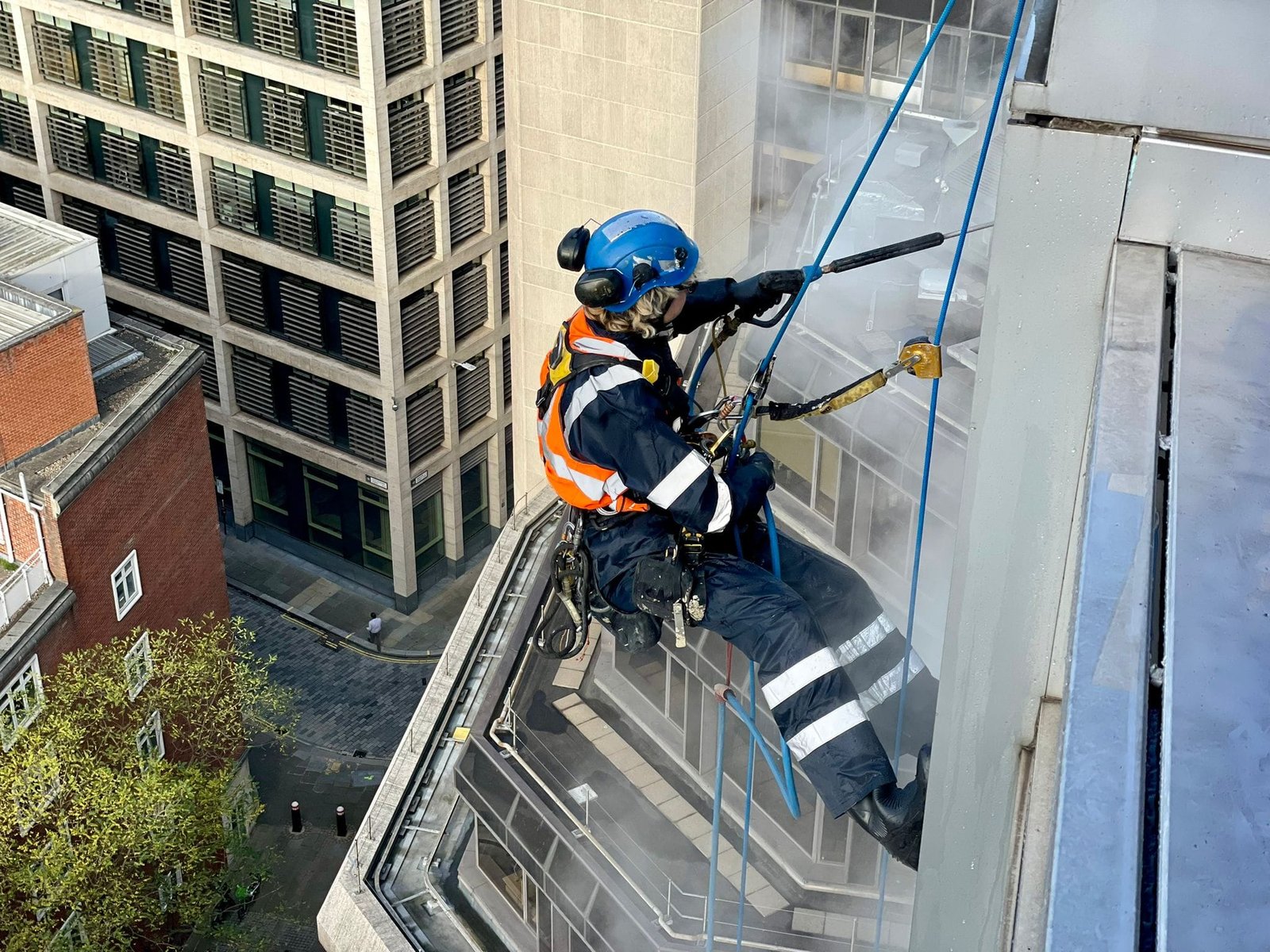
Rope access provides direct access to difficult window lines with a smaller ground-level footprint than full scaffolding. It may be suitable where the defect is localised, appropriate anchorage is available and the area below can be safely controlled.

The access method is reviewed before the work is priced. Rope access will only be recommended where it is safe, practical and proportionate to the repair.

Difficult Window Lines

Reach high-level frames, rear elevations, lightwells and courtyard-facing windows.

Less Disruption

Avoid full scaffold where rope access is safe, proportionate and suitable.

Close-Up Inspection

Inspect failed mastic, open joints, frame corners and façade interfaces.

Repair Evidence

Provide photos of visible defects and completed sealant repairs where required.

Rope access or scaffold?

The correct method depends on the scale of the work, the building configuration, anchorage and how often access will be required.

The correct method depends on the scale of the work, the building configuration, anchorage and how often access will be required.

DECISION AREA

ROPE ACCESS

SCAFFOLD

Access setup

Targeted access to the affected window line with less setup where suitable.

Often needs design, license’s, pavement planning and longer mobilization.

Best suited to

Focused inspections, leak tracing and localised sealant repairs.

Larger façade programmes or repeated access over a longer period.

Site disruption

Smaller ground-level footprint and less visual obstruction.

Can affect entrances, windows, public access and tenant experience.

Key requirement

Suitable anchorage, protected rope paths and controlled areas below.

Adequate space, permissions and suitable scaffold design.

Rope access is not automatically the right option for every building. Peak Access reviews the location and scope before recommending an access method.

Inspection scope

What we check before
repairing window sealant

Failed mastic may be the cause, but water can also track from cladding joints, curtain wall interfaces, parapets, copings, gutters, rooflines, masonry cracks or previous repair work.

1. Window frame and sealant

  • Frame perimeter joints
  • External mastic and sealant
  • Frame corners
  • Cills and sill joints
  • Cracked or open sealant
  • Failed adhesion
  • Previous local repairs

2. Surrounding façade details

  • Render and masonry around the frame
  • Cladding interfaces
  • Curtain-wall joints
  • Flashings and trims
  • Cracks or open façade joints
  • Connections between different materials

3. Wider water-entry routes

  • Parapets and coping stones
  • Roofline details
  • Gutters and rainwater outlets
  • Water tracking from levels above
  • Internal damp location
  • Previous leak history

The purpose of the review is to identify whether targeted sealant replacement is appropriate or whether wider water-ingress investigation is required first.

COMMERCIAL & MANAGED PROPERTIES

Window sealant repairs planned around occupied buildings

Peak Access carries out high-level window sealant inspection and repair for property managers, managing agents, facilities teams and commercial building owners across London.

Access, exclusion zones, tenant disruption, working hours and reporting requirements are considered before the work is scheduled.
Managed Residential Blocks

High-level window sealant repairs for communal elevations, apartment blocks and managed estates.

Commercial Offices

Targeted external mastic and perimeter-joint repairs for difficult-access office façades.

Hotels and Estates

Planned repairs where access, appearance and disruption to guests must be carefully managed.

Property Portfolios

Consistent inspection, photographic records and repair support across multiple London properties.

PROJECT EXAMPLE

High-level window sealant inspection and repair

Property type
Commercial building, London

Reported issue
Water ingress was suspected around high-level windows where the external perimeter joints could not be safely inspected from ground level.

Access approach
Rope access was used to reach the affected window line directly, allowing the technician to inspect the external joints at close range without installing full scaffolding.

Works undertaken
The window perimeters, frame joints and adjoining façade interfaces were inspected for cracked, open or debonded sealant. Defective areas were prepared and repaired using a suitable external-grade sealant where required.

Project output

  • Close-range inspection of high-level window joints
  • Identification of visible sealant defects
  • Targeted preparation and remedial sealing
  • Photographic records of the works
  • Recommendations for any areas requiring further investigation

Process

How it works

Send the issue details, the access requirements are reviewed, the affected window line is inspected, and clear findings or repair recommendations are provided.

How does the weather affect window sealant repairs?2026-08-05T02:17:26+01:00

Sealant installation requires suitable surface and weather conditions. Work may need to be postponed during rain, high winds, very low temperatures or where the joint cannot be kept clean and dry. Conditions will be reviewed before and during attendance.

Is the existing sealant removed before new sealant is applied?2026-08-05T02:02:31+01:00

Defective sealant is normally removed from the agreed repair area. The joint is then cleaned and prepared before a compatible external-grade sealant is applied and neatly finished. The precise preparation method will depend on the joint condition and adjoining materials.

Can sealant be replaced around one window only?2026-08-05T02:01:21+01:00

Yes, localised repairs may be suitable where the defect is confined to one window or joint. Where similar deterioration is visible across the elevation, a wider inspection or phased replacement programme may be more appropriate.

What happens when the source of the leak is uncertain?2026-08-05T02:00:38+01:00

A wider water-ingress investigation may be recommended. This can include close-up inspection of the window perimeter, surrounding façade, cladding interfaces, cills, roofline details and previous repairs. Controlled water testing may also be proposed where appropriate.

Can you review photographs before attending the property?2026-08-05T01:58:47+01:00

Yes. Photographs of the internal staining, affected window, visible sealant defects and wider elevation can help establish the likely access and inspection requirements. They may also indicate whether a repair quotation can be prepared or whether an inspection is needed first.

Can high-level window sealant repairs be completed without scaffolding?2026-08-05T01:55:05+01:00

Often, yes. Rope access may provide direct access to affected window lines without installing full scaffolding, provided suitable anchorage, safe rope paths and controlled areas below are available. The access method will be reviewed before the work is priced.

FASTER ENQUIRY TRIAGE

Send photos before arranging access.

A few clear photos can help confirm whether the next step should be targeted mastic repair, window leak detection or a wider façade investigation.

Go to Top